

In this article
Key takeaways
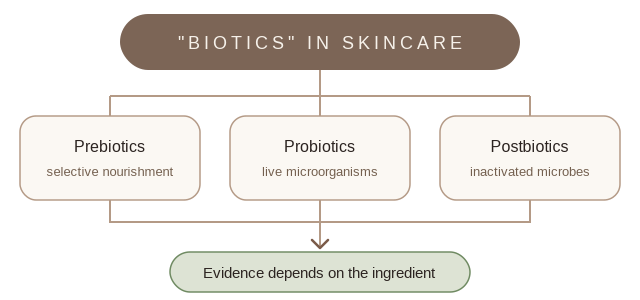
- Prebiotics are ingredients selectively used by microorganisms to provide a health benefit.
- Probiotics are live microorganisms with demonstrated benefits. Many cosmetics marketed as probiotic skincare contain non-living microbial preparations instead.
- Postbiotics are preparations of inactivated microorganisms or their components with demonstrated health benefits.
- These ingredients are being studied for their potential roles in skincare, but evidence varies depending on the specific ingredient and formulation.
- A gentle cleanser, an appropriate moisturiser and daily sunscreen remain the foundations of skin barrier care.
The definitions
What Are Prebiotics, Probiotics and Postbiotics in Skincare?
Scientists have agreed precise definitions for each term. Here they are, with what each one means in plain language.
Prebiotics
Substances that are selectively used by microorganisms in a way that provides a health benefit.1
In simple terms, prebiotics act like nourishment for beneficial microbes. But not every sugar or carbohydrate automatically qualifies as a prebiotic. It has to be shown to be used selectively and to provide a benefit.
Probiotics
Live microorganisms that provide a demonstrated health benefit when administered in adequate amounts.2
The key word is live. A probiotic must contain living microorganisms, in a strain and amount shown to be beneficial.
Postbiotics
Preparations containing inactivated microorganisms and/or their components that provide a demonstrated health benefit.3
Postbiotics are not simply everything that microorganisms produce. Purified microbial substances on their own do not qualify, and inactivating a probiotic does not automatically make the result a proven postbiotic. The benefit has to be demonstrated.
What about "biotics"?
The term "biotics" is often used in skincare to describe ingredients associated with microorganisms and the skin's microbial ecosystem. It commonly includes prebiotics, probiotics and postbiotics.
However, these three categories are scientifically different, and not every ingredient marketed as microbiome-friendly has been clinically shown to change or improve the skin microbiome.
The bigger picture
How Do These Ingredients Relate to the Skin Microbiome?
Your skin barrier and skin microbiome work closely together. The barrier is your skin's outer protective layer. It helps retain moisture and limits exposure to irritants. The microbiome is the community of microorganisms living on and within the skin's surface environment.
These two systems influence each other. Skin pH, moisture, lipids and immune responses help shape which microorganisms thrive. In turn, certain microorganisms interact with the skin's immune responses and protective functions. Read more in our guide What Is the Skin Microbiome? Why It Matters and How to Keep It Balanced.
What does a balanced skin microbiome mean?
A balanced skin microbiome is a microbial community suited to its particular skin environment. Different areas of the body naturally support different microorganisms, and there is no single ideal microbial composition for everyone.
Maintaining a healthy skin environment and barrier is more useful than trying to eliminate specific bacteria or increase microbial diversity indiscriminately. That's why caring for your skin microbiome is about gentle cleansing, appropriate moisturisation, sun protection and thoughtfully formulated skincare.
Side by side
Prebiotics vs Probiotics vs Postbiotics: Key Differences
| Prebiotics | Probiotics | Postbiotics | |
|---|---|---|---|
| What they are | Substances selectively used by microorganisms to provide a health benefit | Live microorganisms with demonstrated health benefits | Preparations of inactivated microorganisms and/or their components with demonstrated health benefits |
| Simple analogy Simplified | Nourishment | Living residents | Prepared microbial components |
| Evidence depends on | The specific substance and its demonstrated activity | The specific strain, dose and intended use | The specific preparation and supporting research |
Ordinary skincare products do not usually contain live probiotics, and not every ferment or lysate qualifies as a postbiotic.
The honest answer
Can Skincare Products Contain Live Probiotics?
Conventional water-based skincare products generally require an effective preservation system and appropriate microbial-quality controls. Keeping live beneficial microorganisms viable in such products can be technically challenging, particularly when preservatives are present.
For this reason, many products marketed as probiotic skincare contain inactivated microorganisms, ferments or lysates instead of live probiotics.
Specially formulated products containing viable microorganisms do exist, but their stability, safety and benefits must be demonstrated for the specific product. Neither form is automatically better: what matters is the evidence for the specific preparation.
Evidence
What Does the Research Say?
Research on topical microbiome-related ingredients is promising but still developing. Here is what some key studies show, and what they don't.
Prebiotics
In laboratory tests, certain carbohydrates supported the growth of skin-friendly bacteria more than less friendly ones.4 Lab study This is a laboratory finding, not a demonstrated clinical outcome on skin.
Probiotics
An early-stage clinical trial tested a live skin bacterium as an experimental treatment for eczema.5 Phase 1 clinical trial This is medical research, not evidence that a cosmetic containing a Lactobacillus ingredient can treat eczema.
Postbiotics
In a two-month trial in women with reactive skin, a cream containing a specific Bifidobacterium longum lysate reduced skin sensitivity compared with a placebo cream.6 Randomised clinical trial This does not mean every postbiotic preparation reduces skin sensitivity.
A systematic review of topical probiotics found encouraging results, but called for larger, well-designed human studies.7 Systematic review
Read the INCI list
How to Identify Prebiotics, Probiotics and Postbiotics on Skincare Labels
Ingredient lists use standard INCI names. These are some you may see on products marketed as microbiome-friendly skincare:
Often marketed as prebiotic
Often marketed as probiotic
Often marketed as postbiotic
Ingredient names can offer clues about a formula's microbiome-related ingredients, but they do not establish whether an ingredient has a proven prebiotic, probiotic or postbiotic effect. The specific preparation, concentration, supporting research and complete formulation all matter.
- Xylitol is not automatically a clinically proven skin prebiotic.
- A ferment filtrate is not automatically a postbiotic.
- A microbial lysate needs appropriate evidence before a postbiotic benefit can be claimed.
- An ingredient with "Lactobacillus" in its name does not necessarily contain live probiotic microorganisms.
Buyer beware
Skincare Claims You Should Be Careful About
- "Billions of live probiotics in every cream." Look for evidence of microbial viability, stability, safety and benefit in that specific product.
- "Restores your skin microbiome instantly." Microbiome composition varies naturally between people and body areas. A restoration claim needs appropriate evidence.
- "Cures eczema or acne." Ordinary cosmetic skincare should not be presented as a substitute for medical treatment.
- "Kills all bad bacteria." Indiscriminately removing microorganisms is not the goal of normal daily skincare. Antimicrobial ingredients do have legitimate medical and hygiene uses.
- "Contains prebiotics, therefore repairs the skin barrier." The presence of an ingredient alone does not establish what the finished product does. The complete formulation matters.
Where they fit
Do You Need Biotic Skincare?
Microbiome-related ingredients are an emerging area of skincare research. Certain preparations may offer benefits for specific skin concerns, but their effects vary.
They are not essential for everyone, and no single biotic ingredient can replace a gentle cleanser, an appropriate moisturiser and daily sunscreen. If your skin feels tight or stings, our guide to the damaged skin barrier explains where to start.
If you have sensitive skin, choose products based on the complete formulation and introduce them gradually.
Watch · Reel
Prebiotic, probiotic, postbiotic: Dr. Priyanka explains
The garden analogy in under a minute, and what to look for on a label.
Watch on InstagramSkincare that listens
How FYBY Essentials Approaches Skin Microbiome and Barrier Health
At FYBY Essentials, we believe healthy skin begins with understanding its natural ecosystem. That's the thinking behind Eubiotic Complex™, our proprietary blend developed around three complementary approaches to microbiome-conscious skincare: Feed, Support and Strengthen.
Prebiotic ingredients
Feed
Selected prebiotic ingredients form the nourishment-focused part of our approach to the skin's microbial environment.
Attenuated Lactobacillus plantarum preparation
Support
Our complex includes an attenuated form of Lactobacillus plantarum as part of our microbiome-focused formulation approach. It is not presented as a live probiotic.
Microbial ferment lysates
Strengthen
Selected microbial ferment lysates form another component. Their potential benefits are understood in relation to the specific preparation, supporting research and complete formulation.
The garden illustrations are a simplified way to explain our approach.
We believe caring for the skin microbiome is only part of the bigger picture. A healthy skin barrier also depends on the complete formulation, from the cleansing system and moisturising ingredients to product pH and overall tolerability. That's why FYBY Essentials focuses on thoughtful formulations designed around everyday skin needs. Learn more in The Science Behind Eubiotic Complex™.
FYBY Essentials. Skincare that listens.
Stay close to the science
Join the Launch Circle for FYBY news and skin science updates from Dr. Priyanka.
Your questions
Frequently Asked Questions
What is the difference between prebiotics, probiotics and postbiotics in skincare?
Prebiotics are substances selectively used by microorganisms to provide a health benefit. Probiotics are live microorganisms with a demonstrated benefit. Postbiotics are preparations of inactivated microorganisms or their components with a demonstrated benefit. In skincare, the evidence depends on the specific ingredient and formulation, not just the category.
Are probiotic skincare products actually alive?
Usually not. Keeping live microorganisms viable alongside preservatives is technically difficult, so many products marketed as probiotic skincare contain inactivated microorganisms, ferments or lysates instead. Products with viable microorganisms do exist, but their stability, safety and benefits need to be shown for that specific product.
Are probiotics and postbiotics the same thing?
No. Probiotics must be live microorganisms. Postbiotics are preparations of inactivated microorganisms or their components. Inactivating a probiotic does not automatically create a proven postbiotic: the resulting preparation still needs its own demonstrated benefit.
Can prebiotics and postbiotics help sensitive skin?
Some specific preparations have shown benefits in studies, such as one bacterial lysate that reduced skin sensitivity in a clinical trial. But results depend on the exact ingredient and formula, and sensitive skin can still react to other ingredients. Introduce new products gradually and choose based on the complete formulation.
Can microbiome skincare support skin barrier health?
It may, as part of a well-formulated routine, but it is not a shortcut. Skin barrier health depends mostly on gentle cleansing, an appropriate moisturiser and daily sunscreen. Microbiome-related ingredients can be a supporting layer, and their effect depends on the specific preparation and the complete formula.
Is applying curd or yogurt the same as probiotic skincare?
No. Curd contains live cultures and lactic acid, but it is not formulated, preserved or tested for use on skin. It can sting or irritate, especially if your skin barrier is already damaged.
Is eating probiotics the same as using probiotic skincare?
No. Eating curd or taking a probiotic supplement acts mainly on your gut. Researchers are studying how the gut and skin influence each other, but oral probiotics do not replace caring for your skin directly, and the two are tested differently.
Can I use microbiome skincare with retinol or exfoliating acids?
Generally, yes. Many microbiome-related ingredients are used in gentle formulas that sit well alongside other products. Introduce one new product at a time, and if retinol or acids are making your skin sting, reduce how often you use them first.
What should I look for in microbiome-friendly skincare?
Look at the whole formula, not just one ingredient: a gentle cleansing system, barrier-supporting moisturisers, a skin-friendly pH and low irritation potential. Be cautious of big claims such as "billions of live probiotics" or "restores your microbiome" unless the brand can show evidence for that specific product.
Do I need prebiotics, probiotics and postbiotics in my skincare routine?
Not necessarily. They are optional. A gentle cleanser, an appropriate moisturiser and daily sunscreen matter most. Microbiome-related ingredients may be a helpful addition for some people, but they cannot replace these foundations.
Sources
References
Each source is labelled by type of evidence, so you can see how strong it is.
- Gibson GR, Hutkins R, Sanders ME, et al. Expert consensus document: The International Scientific Association for Probiotics and Prebiotics (ISAPP) consensus statement on the definition and scope of prebiotics. Nat Rev Gastroenterol Hepatol. 2017;14(8):491-502. Expert consensus
- Hill C, Guarner F, Reid G, et al. Expert consensus document: The International Scientific Association for Probiotics and Prebiotics consensus statement on the scope and appropriate use of the term probiotic. Nat Rev Gastroenterol Hepatol. 2014;11(8):506-514. Expert consensus
- Salminen S, Collado MC, Endo A, et al. The International Scientific Association of Probiotics and Prebiotics (ISAPP) consensus statement on the definition and scope of postbiotics. Nat Rev Gastroenterol Hepatol. 2021;18(9):649-667. Expert consensus
- Bockmühl D, Jassoy C, Nieveler S, et al. Prebiotic cosmetics: an alternative to antibacterial products. Int J Cosmet Sci. 2007;29(1):63-64. Lab study
- Nakatsuji T, Hata TR, Tong Y, et al. Development of a human skin commensal microbe for bacteriotherapy of atopic dermatitis and use in a phase 1 randomized clinical trial. Nat Med. 2021;27(4):700-709. Phase 1 clinical trial
- Guéniche A, Bastien P, Ovigne JM, et al. Bifidobacterium longum lysate, a new ingredient for reactive skin. Exp Dermatol. 2010;19(8):e1-e8. Randomised clinical trial
- Knackstedt R, Knackstedt T, Gatherwright J. The role of topical probiotics in skin conditions: a systematic review of animal and human studies and implications for future therapies. Exp Dermatol. 2020;29(1):15-21. Systematic review
This article is for general education only and does not replace personal medical advice. Cosmetic products, including FYBY Essentials, are not intended to diagnose, treat or cure any skin condition. If you have persistent or worsening skin symptoms, please consult a dermatologist.