
In this article
Key takeaways
- The skin microbiome is the community of bacteria, fungi and viruses that live on and in your skin. Most are normal residents of healthy skin.
- A balanced skin microbiome is one suited to each area of your skin. There is no single ideal mix for everyone.
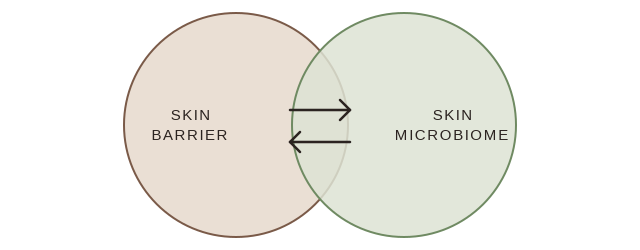
- The skin microbiome and skin barrier work together. Support one, and you support the other.
- Gentle cleansing, a good moisturiser and daily sunscreen are the foundation of microbiome-friendly skincare.
The basics
What Is the Skin Microbiome?
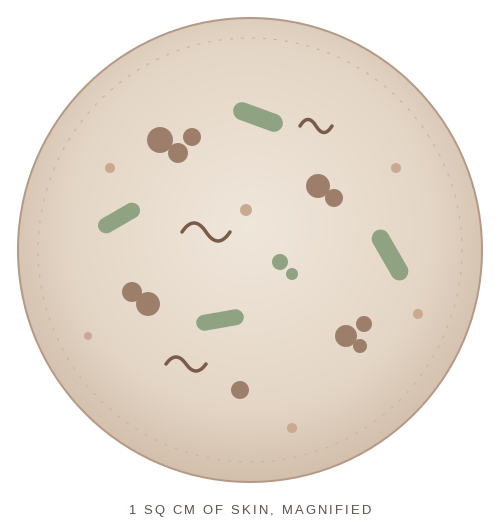
The skin microbiome is the community of microorganisms, mainly bacteria along with fungi, viruses and tiny mites, that live on the surface of your skin and within its hair follicles and glands. Most of them are normal, harmless residents of healthy skin.
Different areas, different communities
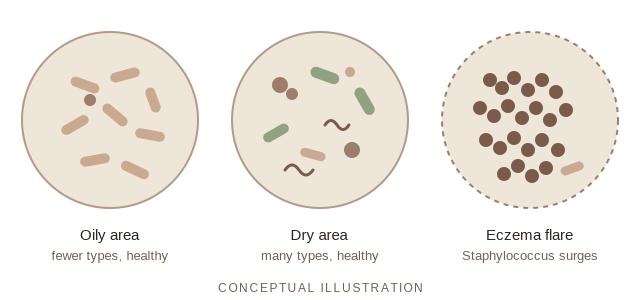
Your skin is not one habitat but many. Oily, moist and dry areas each support their own communities, and each is normal for that area.1
Oily
Face, scalp, chest, upper back
Oil-loving Cutibacterium thrive on sebum here.
Moist
Underarms, inner elbows, behind the knees
Staphylococcus and Corynebacterium lead the community.
Dry
Forearms, hands, legs
The most varied mix of all, with many different species side by side.
Hair follicles: a hidden reservoir
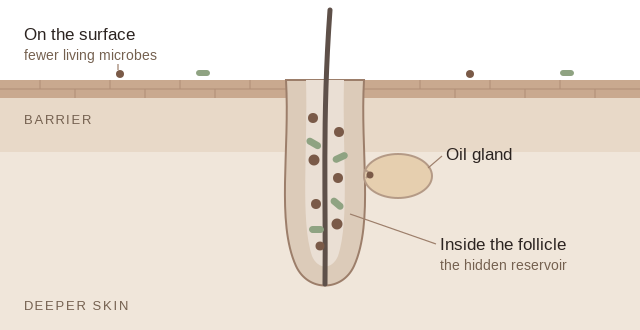
Recent research suggests that hair follicles can act as important reservoirs for viable skin bacteria. This may help explain why certain microbial communities persist even after surface cleansing.2
Skin communities also tend to bounce back after short-term disruption, such as an antiseptic wipe.3
Did you know?
Watch · Reel
Dr. Priyanka explains the skin microbiome in under a minute
Prefer to watch? See what lives on your skin, and why "squeaky clean" is not the goal.
Watch on InstagramWhy it matters
Why Is the Skin Microbiome Important?
Your resident microbes are not just passengers. Research suggests they help with several everyday jobs:
Defending against unwanted microbes
Some resident strains make their own antimicrobial molecules that act against Staphylococcus aureus, a bacterium linked to eczema flares. These strains were found less often on the skin of people with eczema.6 Human and lab study
Training the immune system
Mice raised without microbes had weaker skin immune responses until a common skin bacterium was introduced.7 Animal study
Working with the skin barrier
Experimental research has shown that certain strains of Staphylococcus epidermidis can contribute to processes involved in skin barrier function, including ceramide-related pathways. Some of these findings come from animal studies, and further research is needed to understand their clinical relevance in humans.8 Lab and animal study
These findings are exciting, but they do not mean that any skincare product containing microbial ingredients automatically produces the same effects.
Balance
What Does a Balanced Skin Microbiome Mean?
A balanced skin microbiome is a community of microorganisms suited to your skin's particular environment. These microorganisms interact with the skin barrier and immune system in ways that support normal skin function.
Importantly, there is no single ideal microbial composition for everyone. Different areas of your skin naturally support different microbial communities.
When the balance shifts: eczema
In a study involving children with atopic dermatitis, researchers observed that Staphylococcus bacteria accounted for a much larger proportion of bacterial sequences during untreated eczema flares than at baseline.9
This illustrates how microbial communities can change during inflammatory skin conditions. However, these findings do not mean that every person with eczema has the same microbial pattern.
Share of bacterial DNA sequences that were Staphylococcus
Other skin concerns
Acne
Research has found differences in which strains of Cutibacterium acnes are present on acne-prone skin and how they interact with it.10 Acne is not simply a case of "good" versus "bad" bacteria.
Food sensitisation
Babies with eczema are more likely to become sensitised to foods.11 This is an association, and the microbiome's role is still being studied.
Microbiome and barrier
How Are the Skin Microbiome and Skin Barrier Connected?
The skin barrier: a wall thinner than paper
Your skin barrier is the outermost layer of your skin, called the stratum corneum. It is only 10 to 20 micrometres thick, thinner than a sheet of paper, yet it keeps water in and helps keep irritants out.
Dermatologists often describe it as a brick wall:12
- Bricks are corneocytes, flattened skin cells.
- Mortar is made of intercellular lipids, mainly ceramides, cholesterol and free fatty acids.
- Together, they form the protective barrier and help reduce excessive water loss.
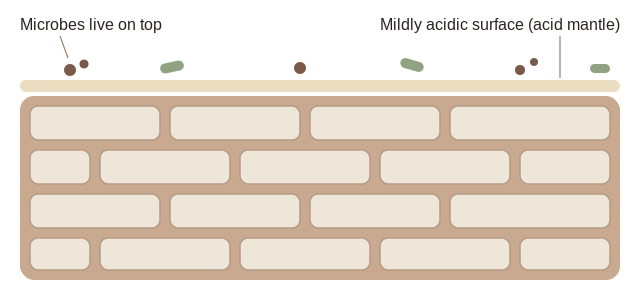
Corneocytes, flattened skin cells
Intercellular lipids, mainly ceramides, cholesterol and free fatty acids
The acid mantle
Healthy skin generally maintains a mildly acidic surface, commonly called the acid mantle. Skin surface pH varies between individuals and different body areas, but this mildly acidic environment contributes to normal barrier function and helps shape the skin's microbial ecosystem.
pH influences the enzymes that build barrier lipids12 and which microbes thrive. In one study of 330 people, average skin pH was about 4.7, skin below pH 5 had better barrier function, and resident bacteria attached better under acidic than alkaline conditions.13 That is a study finding, not proof that an alkaline wash permanently removes beneficial bacteria.
A two-way partnership
A healthy skin barrier gives microbes a stable home. When the barrier is damaged, the skin's surface changes, and so can its microbial community.
If your skin feels tight, stings or flakes, read our guide Damaged Skin Barrier: Signs, Causes and How to Support It.
Everyday disruptors
What Can Disturb Your Skin Microbiome?
Some factors are known to affect the skin barrier. Fewer have been shown to change the skin microbiome directly.
| Factor | What we know | Microbiome evidence |
|---|---|---|
| Over-cleansing and over-exfoliating | Can strip barrier lipids and raise skin pH. In one study, even plain tap water raised skin pH for several hours.13 | Limited |
| Antiseptics and antibacterial washes | Reduce microbes along with germs. | Short-term shifts shown in people3 |
| UV exposure | Damages the barrier and contributes to skin ageing. | Changes in composition shown in people14 |
| Hard water | An observational study found an association between higher domestic water hardness and eczema in early infancy. However, this does not establish that hard water directly causes eczema.15 | Not established |
| Air pollution | Air pollution can contribute to oxidative stress and skin pigmentation concerns.16 | Being researched |
| Dry air and climate | Low humidity and cold can weaken the barrier and are linked to more eczema flares.17 | Being researched |
| Stress and poor sleep | Stress and inadequate sleep can influence skin barrier function and recovery.1819 | Being researched |
Skin in India
Why this matters even more here
- Hard waterMany homes, especially those on borewell supply, wash with mineral-rich water every day.
- Strong sunHigh UV for most of the year means daily exposure, not just holiday exposure.
- City pollutionTraffic soot and fine dust settle on skin through the day.
- Climate swingsHot, humid summers and monsoons give way to dry winters and air-conditioned rooms.
In deeper skin tones, irritation is also more likely to leave dark marks (post-inflammatory hyperpigmentation), so a calm, well-supported barrier matters even more.
Myth
If my skin feels tight and squeaky clean after washing, it means I've cleansed it properly.
Fact
Skin that feels persistently tight or uncomfortable after washing may be experiencing excessive cleansing or inadequate moisture support. A good cleanser should remove dirt and excess oil without leaving your skin feeling stripped.
Everyday care
6 Ways to Support a Healthy Skin Microbiome
How to improve your skin microbiome is less about adding more and more about doing less, more gently.
Cleanse gently
Use a mild, pH-balanced cleanser and lukewarm water. Your skin should feel comfortable afterwards, not stripped.
Support the barrier
Moisturise daily. Look for ceramides, cholesterol and fatty acids, which resemble your barrier's own lipids.
Go easy on antibacterials
Keep antibacterial washes for when you need them, not your everyday face, unless your doctor advises otherwise.
Exfoliate less
Introduce one active ingredient at a time and give your skin time to adjust.
Protect and reset
Wear sunscreen every day, and cleanse gently at night to remove sunscreen, sweat and pollution.
Rest and recover
Good sleep and lower stress support your barrier's natural recovery.
If redness, itching, rash or pain persists, see a dermatologist. Ongoing symptoms deserve a proper diagnosis, not more products.
Ingredients
What Are Prebiotics, Probiotics and Postbiotics in Skincare?
Prebiotics are substances selectively used by microorganisms to provide a health benefit.20 Probiotics are live microorganisms that provide a demonstrated health benefit when used in adequate amounts.21 Postbiotics are preparations containing inactivated microorganisms or their components that provide a demonstrated health benefit.22
In skincare, products marketed as probiotic skincare often contain non-living microbial preparations, ferments or lysates rather than live probiotics.
Research into these microbiome-related ingredients is promising, but their benefits depend on the specific preparation and complete formulation. Our guide Prebiotics, Probiotics and Postbiotics in Skincare: What's the Difference? explains each one in detail.
Skincare that listens
How FYBY Essentials Approaches Skin Microbiome and Barrier Health
Think of your skin as a garden: it thrives when you tend it gently rather than strip it bare. That is the idea behind Eubiotic Complex™, our proprietary blend in FYBY Essentials, built on three steps:
Prebiotic ingredients
Feed
Nourishment for the beneficial microbes that already live on your skin.
Attenuated Lactobacillus plantarum preparation
Support
An attenuated Lactobacillus plantarum preparation forms part of our microbiome-conscious ingredient approach.
Microbial ferment lysates
Strengthen
Selected microbial ferment lysates form another part of Eubiotic Complex™. Their potential benefits are considered alongside the complete formula.
Eubiotic Complex™ is formulated around ingredient-level research and our philosophy of gentle, barrier-first care. Learn more in The Science Behind Eubiotic Complex™.
FYBY Essentials. Skincare that listens.
Stay close to the science
Join the Launch Circle for FYBY news and skin science updates from Dr. Priyanka.
Your questions
Frequently Asked Questions
What are the signs of an unbalanced skin microbiome?
There is no single sign, and symptoms alone cannot tell you that your skin microbiome is unbalanced. Microbial changes have been seen alongside concerns such as eczema flares and some types of breakouts, but these have many causes. If your skin stays red, itchy, flaky or keeps breaking out, see a dermatologist for a proper assessment.
How can I maintain a balanced skin microbiome?
Keep your routine simple. Cleanse gently with a mild, pH-balanced cleanser and lukewarm water, avoid over-exfoliating and daily antibacterial washes, moisturise to support skin barrier health, wear sunscreen every day, and protect your sleep. Microbiome-friendly skincare ingredients may add support, but these basics matter most.
Can I restore my skin microbiome naturally?
Often, skin communities recover on their own once the cause of disruption, such as harsh cleansing or over-exfoliation, is removed. Research shows resident communities tend to bounce back after short-term disruption. Gentle, consistent care gives your skin the best conditions to recover. Persistent problems deserve a dermatologist's assessment.
Does washing my face remove beneficial bacteria?
Washing removes some surface microbes temporarily, but gentle washing does not wipe out your skin microbiome. Hair follicles act as reservoirs that help reseed the surface. Harsh, high-pH cleansers, very hot water, over-washing and daily antibacterial washes are more likely to disturb your skin.
Are prebiotics and postbiotics necessary in skincare?
No, they are optional. Gentle cleansing, a good moisturiser and daily sunscreen matter most. Prebiotics and postbiotics may be a helpful addition, particularly for dry or sensitive skin, but research is still developing.
Is microbiome-friendly skincare suitable for sensitive skin?
Often, yes, because it tends to favour gentle, low-irritation formulas. However, "microbiome-friendly" is not a regulated term, and sensitive skin can still react to fragrance or other ingredients. Try any new product on a small area for a few days first, and see a dermatologist if irritation persists.
Is the skin microbiome the same as the gut microbiome?
No. Your skin is cooler, drier, saltier and more acidic than your gut, so it supports a different set of microbes. Researchers are studying how the two influence each other, often called the gut-skin axis, but they are separate communities.
Questions about barrier recovery? See our guide to the damaged skin barrier.
Sources
References
Each source is labelled by type of evidence, so you can see how strong it is.
- Grice EA, Kong HH, Conlan S, et al. Topographical and temporal diversity of the human skin microbiome. Science. 2009;324(5931):1190-1192. Human study
- Acosta EM, Little KA, Bratton BP, et al. Bacterial DNA on the skin surface overrepresents the viable skin microbiome. eLife. 2023;12:RP87192. Human study
- SanMiguel AJ, Meisel JS, Horwinski J, Zheng Q, Grice EA. Antiseptic agents elicit short-term, personalized, and body site-specific shifts in resident skin bacterial communities. J Invest Dermatol. 2018;138(10):2234-2243. Human study
- Gallo RL. Human skin is the largest epithelial surface for interaction with microbes. J Invest Dermatol. 2017;137(6):1213-1214. Expert commentary
- Fierer N, Hamady M, Lauber CL, Knight R. The influence of sex, handedness, and washing on the diversity of hand surface bacteria. Proc Natl Acad Sci USA. 2008;105(46):17994-17999. Human study
- Nakatsuji T, Chen TH, Narala S, et al. Antimicrobials from human skin commensal bacteria protect against Staphylococcus aureus and are deficient in atopic dermatitis. Sci Transl Med. 2017;9(378):eaah4680. Human, lab and animal study
- Naik S, Bouladoux N, Wilhelm C, et al. Compartmentalized control of skin immunity by resident commensals. Science. 2012;337(6098):1115-1119. Animal study
- Zheng Y, Hunt RL, Villaruz AE, et al. Commensal Staphylococcus epidermidis contributes to skin barrier homeostasis by generating protective ceramides. Cell Host Microbe. 2022;30(3):301-313. Lab and animal study
- Kong HH, Oh J, Deming C, et al. Temporal shifts in the skin microbiome associated with disease flares and treatment in children with atopic dermatitis. Genome Res. 2012;22(5):850-859. Human study
- Fitz-Gibbon S, Tomida S, Chiu BH, et al. Propionibacterium acnes strain populations in the human skin microbiome associated with acne. J Invest Dermatol. 2013;133(9):2152-2160. Human study
- Flohr C, Perkin M, Logan K, et al. Atopic dermatitis and disease severity are the main risk factors for food sensitization in exclusively breastfed infants. J Invest Dermatol. 2014;134(2):345-350. Observational human study
- Elias PM. Stratum corneum defensive functions: an integrated view. J Invest Dermatol. 2005;125(2):183-200. Scientific review
- Lambers H, Piessens S, Bloem A, Pronk H, Finkel P. Natural skin surface pH is on average below 5, which is beneficial for its resident flora. Int J Cosmet Sci. 2006;28(5):359-370. Human and lab study
- Burns EM, Ahmed H, Isedeh PN, et al. Ultraviolet radiation, both UVA and UVB, influences the composition of the skin microbiome. Exp Dermatol. 2019;28(2):136-141. Human study
- Perkin MR, Craven J, Logan K, et al. Association between domestic water hardness, chlorine, and atopic dermatitis risk in early life: a population-based cross-sectional study. J Allergy Clin Immunol. 2016;138(2):509-516. Observational human study
- Vierkötter A, Schikowski T, Ranft U, et al. Airborne particle exposure and extrinsic skin aging. J Invest Dermatol. 2010;130(12):2719-2726. Observational human study
- Engebretsen KA, Johansen JD, Kezic S, Linneberg A, Thyssen JP. The effect of environmental humidity and temperature on skin barrier function and dermatitis. J Eur Acad Dermatol Venereol. 2016;30(2):223-249. Scientific review
- Garg A, Chren MM, Sands LP, et al. Psychological stress perturbs epidermal permeability barrier homeostasis: implications for the pathogenesis of stress-associated skin disorders. Arch Dermatol. 2001;137(1):53-59. Human study
- Oyetakin-White P, Suggs A, Koo B, et al. Does poor sleep quality affect skin ageing? Clin Exp Dermatol. 2015;40(1):17-22. Observational human study
- Gibson GR, Hutkins R, Sanders ME, et al. Expert consensus document: The International Scientific Association for Probiotics and Prebiotics (ISAPP) consensus statement on the definition and scope of prebiotics. Nat Rev Gastroenterol Hepatol. 2017;14(8):491-502. Expert consensus
- Hill C, Guarner F, Reid G, et al. Expert consensus document: The International Scientific Association for Probiotics and Prebiotics consensus statement on the scope and appropriate use of the term probiotic. Nat Rev Gastroenterol Hepatol. 2014;11(8):506-514. Expert consensus
- Salminen S, Collado MC, Endo A, et al. The International Scientific Association of Probiotics and Prebiotics (ISAPP) consensus statement on the definition and scope of postbiotics. Nat Rev Gastroenterol Hepatol. 2021;18(9):649-667. Expert consensus
This article is for general education only and does not replace personal medical advice. Cosmetic products, including FYBY Essentials, are not intended to diagnose, treat or cure any skin condition. If you have persistent or worsening skin symptoms, please consult a dermatologist.